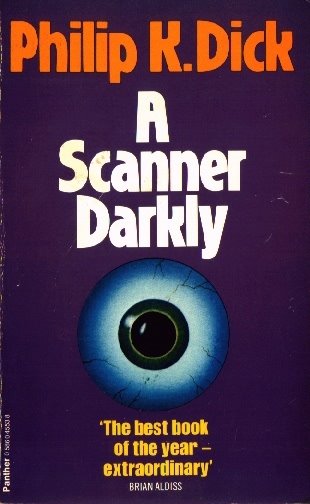
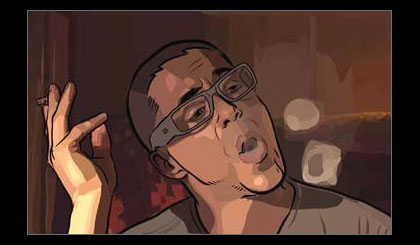
Went to the Waterman's to see Richard Linklater's version of the Philip K.Dick Sci-Fi novel "A Scanner Darkly" last night with Susie.The animation-style 'rotoscoping' was interesting, and well suited to the trippy topic, and certainly better than watching another tedious CGI-fest. Read the original book many years ago, and have fond memories of it, but it seemed a lot less episodic and unresolved than the film. Maybe I need to read it again to try and make more sense of it though.
The ever wooden Keanu is definitely meant to be a comic book character, in fact maybe he doesn't really exit at all and is just a Hollywood C21 leading man CGI construct.
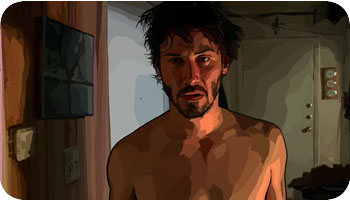
The central theme that societies ills are invented by the same faceless corporations that then provide the solutions to those problems ( at a profit) wasn't bludgeoned hamfistedly into your face, in fact trying to follow who was who and what the hell was going on required considerable effort. This opacity was certainly a deliberate disorientating effect, but us old folk struggle with this hi-tech post-modern mish-mash sometimes
This, from the Philip K. Dick foundation (run by his kids) gives the film a certain legitimacy:
"A Scanner Darkly is one of our father's most personal stories because much of it is based on his own experiences. For this reason, it was especially important to us that it be done with all of the right intentions. His struggle with drug abuse is well documented, and he (and we) have witnessed many casualties. The novel is filled with his humour and his own tragedies. And we believe that Richard Linklater's screenplay manages to capture these key elements -- he has even included our father's poignant afterword in his adaptation."
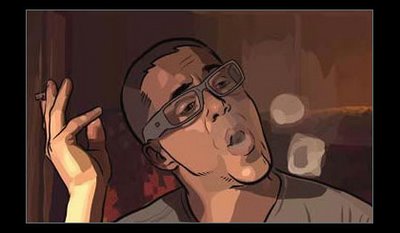
And this quote from "Publishers Weekly", gives some sense of the dense layers of spaced out paranoia:
"America in the near future has lost the war against drugs. Though the government tries to protect the upper class, the system is infested with undercover cops like Fred, who regularly ingests the popular Substance D as part of his ruse. The drug has caused Fred to develop a split personality, of which he is not aware; his alter ego is Bob, a drug dealer. Fred's superiors then set up a hidden holographic camera in his home as part of a sting operation against Bob. Though he appears on camera as Bob, none of Fred's co-workers catch on: since Fred, like all undercover police, wears a scramble suit that constantly changes his appearance, his colleagues don't know what he looks like. The camera in Fred/Bob's apartment reveals that Bob's intimates regularly betray one another for the chance to score more drugs. Even Donna, a young dealer whom Bob/Fred loves, prefers the drug to human contact. Originally published in 1977, the out-of-print novel comes frighteningly close to capturing the U.S. in terms of the drug crisis and the relationships between the sexes. But the unrelenting scenes among the addicts make it a gruelling read."
Good quote from the Grauniad:
"It is an odd fable that partakes of, and seems to endorse, the crazed ramblings of its demented, paranoid characters..."
Read it, then watch it.....or vice versa...or smoke it!

Labels: Film